
******* Click here to go to the most current version
Ideas: Before we begin, here is a fitting thought by Percy Sutton that's worthy of quotation :
"If you pray for only one thing, let it be for an idea."
Requesting that soccer rules be changed is not all that uncommon, it's just that most ideas publicly presented are knee jerk responses to unusual situations, and don't include any real thought for how they might affect the gestalt of soccer. Consider this example suggested by a Liverpool Executive after the 2006 FA Cup Final - the addition of a 4th substitute in overtime - presented to avoid the reoccurrence of a shoot-out. Rick Parry's quote: "It would make it less of a lottery." is somewhat confusing, as 'IT' could be read as the wealthier club's more talented substitute would help to insure that deeper pockets prevail, or it could simply reveal the hatred of the English for the shoot-out. Either way, Parry's quote: "Maybe the issue should be raised with the Football Association." shows that this was serious discussion of a change to the rules of soccer. Now it's my turn...
A. Make 'Pushing Forward' Fashionable via Simple Changes to the Scoring System
Embrace only Stealth Changes. One thing I have come to recognize is that the best changes to the pro game are those which could be totally ignored by the non-professional leagues and players. I call these changes 'Stealth Changes.' They encourage the pro player to behave differently, but the game would be in the same state is was in after FIFA did away with scoring goals by knocking the goalkeeper into the goal.
The best way to accomplish Stealth Changes is to switch to a completely different scoring format.
The most very basic change in the scoring system for American Professional Soccer should be to use it as a way to encourage attacking play. This is easily done by reviewing the layout of the field at the time that a goal was scored to determine first if a goal was truly scored, and then if the team which scored the goal was 'pushing forward' at the time the goal was scored, and if they weren't, then was the defending team found to be 'pushing forward'. The exception would be the scoring off of a corner kick, which should be based on the player placement at the time the corner kick was earned. Failing to make this exception would result in a disproportionately high value in the corner kick, something I'm trying to avoid like the plague, since I feel that the corner kick already accounts for way too high a percentage of total goals scored.
Here's an example of how this system could be structured:
A. 3 points for any goal scored.
B. 2 additional points if one or fewer members of the offensive team were positioned at least partially behind the midfield line.
C. 2 additional points if fewer than 2 members of the defensive team were at least partially on the far side of the midfield line.
And the beauty of this scoring system is that it need not influence how soccer is played outside the Professional ranks, since the key to making this work is the use of simple video recorder technology covering the entire field, including a printer which can print out the still pictures for record keeping purposes.
But you must check out my page "soccer-scoring-systems1" for more on this and other more radical scoring system ideas, which after years of consideration, is the only way to make the following possible, which will really open up offensive oriented play.
B. Discourage the Double Team
It's November 13, 2006, and yesterday was as wonderful a day in soccer as I can hope to experience. Over to Dallas' Trinity Hall Pub to watch The Arsenal put the hurt on Liverpool 3-0, then over to Frisco's Pizza Hut Park to see the MLS Cup Championship Match, or at least I saw regulation time, because just as I did last year, I left after regulation finished 0-0. I realize it's my problem, but I didn't have a team on the field, so I'd had enough of a good thing.
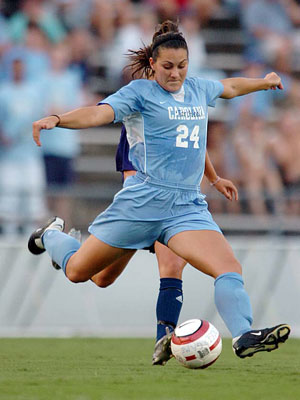
But the big news came when I checked the internet and discovered that the Lady Tarheels of North Carolina had won both of their NCAA tournament matches, and did so in impressive fashion. Check it out:
UNC-Chapel Hill v. UNC-Ashville (box score)
Shots Taken: UNC-Chapel Hill 35 UNC-Asheville 2
Corner Kicks: UNC-Chapel Hill 9 UNC-Asheville 0
UNC-Chapel Hill v. Navy (box score) (note: Going into this match, Navy was 21-1-1 and had allowed only 5 total goals!!! )
Shots Taken: UNC-Chapel Hill 20 Navy 1
Corner Kicks: UNC-Chapel Hill 10 Navy 1
Total Shots and Corner Kicks for the weekend: UNC-Chapel Hill 84 Opponents 4
Obviously, USC's opponents aren't being allowed to move the ball into the offensive third of the field. The Lady Tarheels secret to that kind of domination is an attacking midfield which encourages the double-team whenever an opponent has possession of the ball for more than 2 seconds, and sometimes even sooner than that.
So what, you say? This doesn't translate to American professional soccer, you say? Actually, I feel that it does apply simply because this is a case study on the maximum number of shots in a match, and that's important because many feel that on average 40 shots should be taken to achieve a 3-2 average score. What we see in the first example is that, even in a totally one sided match-up, the total number of shots maxes out between 40 & 50.
I'm not making a criticism of North Carolina here, but is instead a statement of fact about an ugly mindset of the beautiful game, which I like to call Soccer's Primary Defensive Directive:
Unless retreating back toward his own goal, a ball handler must be fouled if thought to be escaping a double team situation.
It's one thing for a ball handler to come face to face with a super talented All-American National Team Player, but when you know that an equally talented opponent is roughly 2 seconds from sliding in to your legs, it's simply too much for any player of similar size and strength to overcome, particularly when you are 100% guaranteed that those two world class opponents will surely foul you if it looks like you're going to slip away...because that's what any coach would want them to do!
Now look to my double team page for my thoughts on how this translates to professional soccer, and the logic behind my conclusion that there is only one way to regulate the double team...through an alternative scoring system.
Now, consider for a moment that North Carolina employs a 3 man back line, a fact which severely undermines the following idea.
C. Restrict the Formations to Limit the Number of Defensive Players

The Dallas Morning News (July 25, 2001, page 3B) reported that the
secret to the 8.8 goal average of the last 5 MLS All-Star games was:
"...teams use a 3-5-2 alignment with a heavy accent on the "5" and
the "2" (midfielders and forwards). And defensive-minded midfielders
are seldom chosen."
Frankly, I've got to give this a lot more thought, but I will say that the MLS All-Star
game of 1999 was one of the most enjoyable soccer game I've ever watched,
and believe me, the 6-4 final score is the reason why. I only wonder if this would
be difficult to officiate? And how do you go about convincing the midfielders that
their time is better spent concentrating more on offense than on defense, even when
their team is up by a goal or two? Correction...make that especially when their team
is up by a goal or two. Luckily, item "D" gives us the answer to this query - NOT!!!!!.
Note #1: Before we get on to the folly which is Idea E, let's talk more about this
alignment issue. There is a major flaw in thinking that a 3 back line will produce more
entertaining soccer than will a 4 back line configuration. If that 4th back is removed in
favor of a 3rd forward, resulting in a 3-4-3 setup, then you can expect more goals and
more entertaining soccer. But sadly, the move from a 4-4-2 to a 3-5-2 will likely result
in a denser and more double team oriented midfield. Now class, what strategy is used
to attack a denser and more double team oriented midfield, particularly when behind
such a midfield is a 3 back line?
Very good class! The answer is to kick over the top of that denser midfield toward
that tempting 3 back line! And not just occasionally, but almost every single time
that a defensive soccer player gets a toe on the ball...at least until a 2 goal lead is
achieved. So, my point here is that - in the real world of today's professional and
college game - requiring a 3 back configuration will not guarantee entertaining soccer,
as non-stop over the top soccer is far from entertaining, even if the final score is 5-3.
D. Limit the Defensive Header (Caution! You Are Approaching A Really Bad Idea!)
What's next in the defenders quiver? The header! This is an easy one. Prohibit
heading of the ball directly back up the field to another player. The defender can
control the ball to his or her own feet, but a pass to a team mate must be to a side
line or back to the goalkeeper. The pass need not be perfectly to the side, so a
15 degree angle forward up field is acceptable, but not 30 degrees, and definitely
not 45 degrees. OK coaches, what is the obvious effect of the fact that the sweeper
must go to the side with every header? That's right...the 3 forward system. With the
sweeper or stopper forced to go to the sidelines with headers, the center forward
would be there placing pressure, so only a goofy coach would fail to have forwards
on both sides to capitalize on the inevitable misplays. The kind of misplays which
create breakaways and a 1 v. 1 with the goalkeeper, thereby creating entertaining
soccer. And what does a 3 forward system mean? Either fewer defensive backs,
or more likely fewer midfielders, but either way it's means fewer defenders, and
more room to create offense. Hey, if you can come up with another way to entice
coaches to use a 3 forward system all the time, I'd love to hear it. It's taken a year
for me to come up with this idea.
SCORING INCREASE: 2-3 goals per game
Note: This is a terrible idea. I'm thinking that it must have been the result of two
medications reacting badly. Thankfully, the soccer I've watched this fall of 2003
has opened my eyes to the evils of non-stop "over the top soccer", as it's far less
entertaining than a low scoring ground based game could ever be.
E. Encourage the 3 Defender Formation via the Corner Kick
At the beginning of each match the captain of each team informs the referee whether they plan to use a 3 defender back line or a 4 defender back line, and who will be playing central back (3 man back line) or central backs (4 man back line). Option #1: Using the 3 defender back line permits the taking of standard corner kicks, while employment of the 4 defender back line means that throw-ins are to be used in place of corner kicks. Option #2: During corner picks, the central back (or backs) are not allowed to move further up field than the mid-field line. A 3 man back line means that there is only one central defender, so only that defender is held back at the mid field line.
F. Encourage Upright Defense
What's the biggest misconception in soccer? That a defensive player
will only leave his feet for a dive in or a slide tackle as a "last resort."
The reality is that far too many players will use such 'horizontal' tactics
as the preferred weapon of attacking defense.
Our challenge here is to change the player's focus from what is "MY last
resort" to one of "MY TEAM'S last resort." Consider the large number
of times when forwards or midfielders dive in horizontally at a
time when most of their defenders are still behind them. I estimate
that only about 10% of dive ins and slide tackles are executed at a
moment which truly is the team's last resort.
The fact is that defensive players use the dive in and slide tackle
whenever it affords them the best chance of taking the ball from the
player who is controlling the ball. This is the mindset of attacking defense,
and this mindset must be changed before we'll see higher scoring soccer.
The only way that I can envision changing this mindset is to convince the
defensive player that they should stay on their feet as long as there is a
good chance that there's support behind him or her. How can we
do this and not make a major change to the game of soccer?
Those who have played basketball know that a basketball player
can kick the ball at any time to interrupt the offense, but the
defensive player uses this weapon sparingly because the rules of
basketball do not permit the defense to "win possession" of the ball
by kicking the ball. True, the defense has stopped the play, but the
ball is simply awarded back to the offensive team as a throw-in.
In soccer, we could easily encourage upright defensive with a rule
that does not allow the defense to 'win possession' with any move
where the defensive player's hand or butt touches the ground. Slide tackling
is still allowed, only the defense cannot 'win possession' with a slide tackle.
I'm not talking about a card violation, only that the ball is simply awarded
back to the offense in some way (throw in, etc.). And the continuity of
game isn't greatly affected, because the ref only blows the whistle when
the "hand or butt down" move causes a change in possession. If the slide tackle
deflects the ball to another offensive player, then no whistle is needed as
possession hasn't changed. Instantly the game is improved. With the
defense encouraged to keep their feet and truly use the slide tackle as
a weapon of last resort, the offense would have a lot more room to make
things happen. The end result: more goals, fewer dives, easier to officiate
games, safer games, and the near extinction of the "enforcer" marking
back, whose primary weapon is the "close-up" one or two step slide tackle
which is almost impossible to avoid. Thought must be given as to whether
this rule should apply to goalkeepers, as the most athletic keeper saves
usually result in the keeper's hand touching the ground. Maybe I'm a
little too close to the position (both my kids were keepers), but I
think this rule should not be applied to keepers.
SCORING INCREASE: 2 to 3 goals per game!
Note #1: The biggest impact this change will have is in it's effect on the
defense's ultimate weapon: the double team. Gone will be the tactic of
defender #1 getting in front of his man, allowing defender #2 to approach
from the side at all out speed and then "drop into" the tackle--knocking the
ball free and putting the offensive player off balance--making it easy for
upright defender #1 to recover the ball. Having to stay upright when going into
ANY double team will mean approaching in a slower more controlled fashion
which will no doubt discourage many defender #2's from even initiating the
double team in the first place. Hesitation! It will defang the defense, offering
the offense a freedom of expression not seen since the early '60's.
Note #2: Let me make it clear that we cannot remove slide tackling from
soccer, as the game's players would likely evolve in broad shouldered types
which would look closer to today's rugby players than today's soccer players.
Keeping slide tackling in the game as a true "weapon of last resort" would
mean that the need for a player to be light on his or her feet to step over
the sliding defender would continue to be the first and foremost requirement
of a soccer player. Step over the slide tackle or get seriously injured.
Note #3: If you are a defender and slide tackling is your favorite part of
soccer, let me extend my deepest sympathy, and remind you that you could
slide-tackle any time you please, but you simply can't win possession of the ball
with a slide tackle. Before e-mailing me about how wonderful slide tackling is,
please go to my "slide tackle" page for prepackaged responses on the subject.
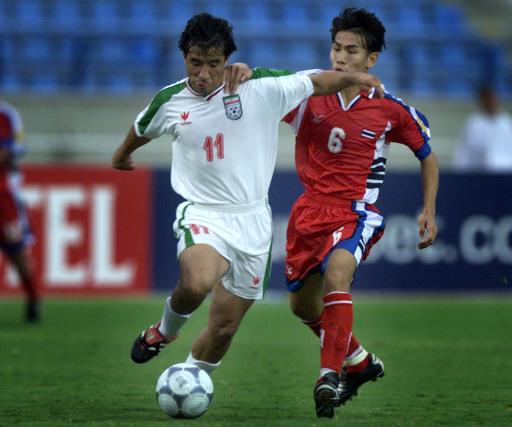
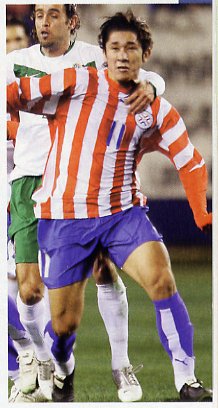
Tools of the defender's trade (#14): The hand furthest from the referee. Photo Credits: Damir Sagdj/REUTERS & World Soccer Magazine, June 2006 issue, page 43.
G. Upright Defense with Greater Continuity (sidelines version)
Much of the feedback I've received regarding 'upright defense' bemoans the
fact that the game's continuity will likely suffer. For those who don't want
the ref to blow his whistle any more than he is currently, we must remove
our focus from penalizing the team via the possession change. Luckily, the
"horizontal tackle" is impossible to overlook (anyone can see it from any angle
except maybe from the Goodyear Blimp), and it is impossible for a player
to NOT be aware that his or her hand or buttocks touched the ground. So why
not penalize the player who executes the horizontal tackle (hands or buttocks
touching the ground while attempting the tackle) by requiring them to immediately
proceed to closest sidelines and step out of bounds with one hand prior to returning to play.
And since there is no doubt in anyone's mind as to whether the player's hand or
buttocks have made contact with the ground, it could be left up to the offending
player to pick himself or herself up from the ground and head immediately for the
side lines. Failure to do so would be a yellow card violation, unless the player chose
to stay on the ground until the next time that the ref stopped play, at which time
the player could immediately return to the action.
Midfield play would clean up immediately for obvious reasons, but you would
still see plenty of horizontal tackles along the side lines, due to the fact that play
would be stopped if the defender succeeds in kicking the ball out of bounds, and
this stoppage of play would allow the player to immediately return to the action.

Make no mistake, this is my personal favorite proposal. No whistle 95% of the
time, and the horizontal tackle still becomes the weapon of last resort as the team
is inconvenienced and the player is forced to do a "wind sprint." The hidden benefits
are worth mentioning here. I personally like the fact
that the players are forced to be truthful with themselves or face the
prospect of a yellow card. Over time, I think that this may slightly
counteract the negative effect of the "gamesmanship" which we
parents have been encouraging in our children from the very start.
Image Credit: Thomas L. Friedman of Golf Digest magazine, 04/2004 issue, p.146
H. Redefine what constitutes a Legal Slide Tackle
Over the many years that I've studied the slide tackling issue, I've finally come
terms with exactly what is needed to satisfy all parties. Let's firmly define the
leg action of a legal slide tackle as the extension of one leg, with the 2nd leg
tucked under the tackler. Here's an example of what I mean:

Photo Credit: Fort Worth Star-Telegram, January 4, 2003, page 12D, photo by Rick Moon.
Fact is, this one simple change will make soccer so much easier to officiate,
while at the same disabling the primary perpetrator in many soccer injuries.
That's right, putting the trailing leg under the tackler is the solution, and the use
of any other slide tackling form should earn a yellow card. For a perfect
example, run you mouse over the following image box:
(Note, if you don't see the image box , go to the DIVX site and download their free CODEC for video playback. It's safe at home and work, and you don't even have to reboot your PC.)
Now we all know that it's still possible to whip through
with the trailing leg when it's tucked under the tackler.
At right should be an example of what that looks like,
and note that result is consistent with what I'm advocating:
yellow card
For examples of other slide tackling forms, go to my page
"slide tackle" for videos which spell it all out.
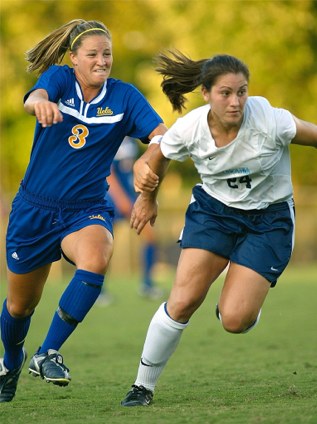
I. The Attacking Players in the Following Photos Would Not Be Offsides
While impossible to implement now, once the Age of Aquarius arrives in American Soccer,
and we are free to enjoy the benefits of the occasional play review by the 4th official,
I'd then suggest that an attacking soccer player cannot be off-sides while a defender
has hands on the attacker, such as in the following examples:
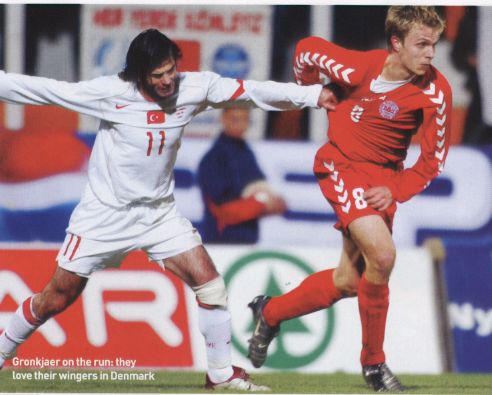
Source: Four Four Two Magazine & www.nc-soccer.com
But I'd like to take this idea a step further. Looking at the above pair of photos,
it's obvious that the beaten player is attempting to control the attacker. This is
typically made easy because the defender 'marks' his or her man by staying very
close to the attacker, sometimes to the point of having a hand on the attacker's back
so that control is just a shove or jersey grab away. Now this would be less of a
problem if we crafted the rule in such a way that any contact between the two players
would keep the attacker on-sides. Do you see where I'm going with this? How can
we encourage the defender to give the attacker some space. Easy! Adjust the
off-sides rule to permit ANY contact between the defender and attacker to hold the
attacker on sides. If the attacker were to simply push off of the defender, then contact
established during the push-off would keep the attacker on-sides.
In today's reality, if the defender isn't standing right by the attacker, the coach is commonly yelling out:
"Ian, why aren't you marking your man?!?"
I'd hope to create an environment where the coach was instead yelling:
"Ian, beware the push off. Give the striker a little space."
J. Goooaaalll---If the Ball Hits the Goal Post and Stays in bounds (Another bad idea!)
This one is simple. If the ball hits the goal post--and stays in bounds--a goal is awarded.
Be careful before you discount this idea. Ask yourself how many goals per game you want in a professional soccer match. Right now the major leagues are floundering at abut 2.7 goals per match. If your dream is to only increase scoring to 4.0 goals per match, why in the world would you be willing to replace all the world's soccer goals when this is the easiest, cheapest, and best way to achieve that insignificant of an increase. I've seen soccer matches where the ball bounced off the goal posts or cross bars 4 different times.
SCORING INCREASE: 1 goal per game
While earlier I regarded this as a harmless alteration, why is it now so clear to me how this drastically changes the essence of the goalkeeper's roll? By telling the goalkeeper that they must keep the ball from touching the goal posts and crossbar is drastically altering the roll of the keeper, and the slight increase in scoring doesn't balance out with the much larger chance of injury to the keeper, and to defenders who will no doubt collide with the goalpost while attempting to clear the ball before contact is made. While a simple way to add a goal to the score of each match, it's just not a safe or smart idea.
K. Reduce Direct Clearing of the Ball Out of Bounds
How much skill is required for a defender to directly kick a soccer ball out of bounds
to stop an offensive challenge? Answer: ZERO. While I freely recognize that most
defensive moves require skill and occasionally even enhance the game of soccer,
direct clearing to the out of bounds by the defense is one practice which can be reduced
greatly with absolutely no fear of diminishing the greatness of the game of soccer.
Solution: Easy, for obvious clearing out of bounds, award the ball to the offensive
team at a point that is half the distance to the goal line from where the kick was made
from, not from where the ball went out of bounds. However, if the defensive player
has made an effort to kick the ball off of an offensive player, then the throw-in
should be given at the point where the ball went out of bounds. Also, if an offensive
player has a clear chance to keep the ball in bounds, but fails to even try to do so, the
throw-in should be awarded at the point where the ball went out of bounds. And yes,
the power of the center ref is maintained by the fact that much of this is open to the
ref's discretion, just as it is with hand balls, off sides, obstruction, and just about every
other ruling in soccer.
SCORING INCREASE: 1 goal per game
Indirect implications: This rule would pretty much keep the goalkeepers in the
18 yard box. Keeper's rarely come out of the box if it isn't to clear the ball hard and
long, and the keeper is never looking to kick the ball off of an offensive player.
L. Clear Out the 6-Yard Box During Corner Kicks
During corner kicks, only the goalkeeper is allowed in the 6-yard goal box
until the ball touches a player other than the player who takes the corner
kick. Idea is to get the other defenders out of the corners of the goal.
SCORING INCREASE: 1 to 2 goals per game
M. Clear Out the 6-Yard Box All The Time
Make the 6-yard box truly the "Keeper's Box." If an offensive player is in the box
at the time a goal is scored, the goal is disallowed and the keeper gets a goal kick.
If a defensive player other than the goalkeeper touches the ball in the box it's a PK
situation.
SCORING INCREASE: 1 to 2 goals per game
Indirect implications: Safer environment for the goalkeeper.
N. Reduce the Keeper's Effectiveness
For those purists who refuse to consider any concept which makes the
American game so different that it might put American players at a
disadvantage in International competitions, we are pretty much limited
to focusing on reducing the effectiveness of the goalkeeper. This can
be done by requiring the keeper to wear indoor soccer shoes during
outdoor matches. This would in effect prohibit the keeper from wearing
spikes (yes, even in wet and sloppy conditions) which would destroy the
keeper's confidence in his or her ability to jump to the side, accelerate off
of the line, back pedaling to get back to the line, and just about every other
aspect of their job where mobility is involved. Take away the keeper's traction
and you'll remove his or her confidence. And there's nothing easier to score
on than a keeper who's confidence is down. During the transition, look for
injuries to be a daily happening, as groin pulls would surely result as the
keepers relearn the limits of their traction. Once the keepers learn to
keep their feet more under their body as they run, the frequency of injury
will fall back to the present "high" level.
O. Put the Keeper in the "Sand Box"
A much more expensive alternative to the spikeless keeper involves
turning the 6 yard box (or the entire penalty area) into the "sand box."
Dig up the sod down to about six inches and replace it with coarse sand.
While the sand will obviously slow down the goalkeeper's ability to move
and will destroy his ability to quickly change directions, the irregular
surface of the sand will make the ball jump unpredictably on low shots.
This will compensate for the fact that the sand will slow down balls rolling
along the surface of the sand. Over time the keepers will prefer the sand
because it will extend their careers by reducing the body's wear and tear.
The wildcard of the "Sand Box" idea is the 'Lip', the interface between
the turf and the sand. Field players will be able to slide from turf to sand
while keepers will not be able to slide from sand to turf for fear of catching
a heal on the "Lip", which might result in a twisted ankle or worse. And
running out over the 'Lip' wouldn't be any less scary for a keeper, so the
keeper would likely stay closer to the line.
P. Keep the Keeper in the 18-yard Box
Restrict the keeper to the 18-yard penalty box when in defensive mode,
but not when the keeper has control of the ball. The keepers will
resist it at first, but will welcome the restriction when the number of
shots on goal (brought on by the above changes) increases by 30 to 40%.
Indirect Implications: This move will have an unintended effect of lowering
the overall scores of many blowouts, since many of the later goals are made
possible by the keeper pushing up to play "keeper/sweeper" while the rest
of the team pushes forward in an effort to create offense. If the keeper was
forced to return to the 18 yard box prior to being able to touch the ball
defensively, he wouldn't leave the nest unguarded in the first place.
Q. Track Who Scores "First Goals" and "First Assists"
If we stick to the "World" rules, let's at least add a statistic called
"FIRST GOALS". Why not, when in Pro soccer, if you score first
there's roughly a 50% chance that the opposing team will never
even score a goal, and since the team which scores first in soccer has
about an 85% chance of winning or at least getting a draw in regulation,
why not recognize the "early starters" in the game. The league is
already tracking "winning goal" stats. I feel that the "first goal" is an
even more important measure of a player's contribution under today's
low scoring reality. Check my page entitled "Numbers don't lie, but..."
for further justification. Also, once this "first goal" statistic is added, the
natural next step is to add the "average minutes to first goal" statistic,
which would further define who's really an early starter. Check this out:
Striker First Goals Average Minutes to First Goal
Jason Mathis 8 58
Conor McBride 6 13
But the incompleteness of these 2 columns became obvious to me after following
the then offensive oriented Arsenal of the EPL's 2004-2005 season. During this
time The Gunners were so deep offensively that they could keep Robert Pires on
the bench until the 2nd half. Those fresh legs afforded both Pires and The Gunners
a noticeable advantage. So obviously 2 more columns should be added:
Soccer Striker Games Played Starts First Goals Average Minutes to First Goal
Jason Mathis 29 29 8 58
Conor McBride 30 5 6 13
So long as the first goal is "THE goal", these two statistics must be added.
And why not, when the MLS's 'League' Statistics page contains the following:
RECORD IN ONE-GOAL GAMES
MLS TEAM
W L T PCT
--------------------------------------------
Colorado Rapids 11 5
0 0.688
Chicago Fire
9 5 0 0.643
Los Angeles Galaxy 9 6 0
0.600
Kansas City Wizards 6 4 0 0.600
N.E. Revolution 10 8
0 0.556
MetroStars
7 6 0 0.538
Tampa Bay Mutiny 8 9 0
0.471
Dallas Burn
8 9 0 0.471
Miami Fusion
4 5 0 0.444
Columbus Crew 6
8 0 0.429
D.C. United
5 11 0 0.313
San Jose Earthquakes 2 9 0 0.182
Look over these numbers and you'll rethink how important the first goal is.
R. Eliminate the Humiliation of Assistant Referees
Visit my "Linesman1" page for explanation as to why you won't see me
running the sidelines anytime soon.
S. Should we play with the Red Card Rule?
Check out my page "Red_Card_1" for my thoughts on author Paul Gardner's
ideas to adjust the red card to provide for more entertaining soccer matches.
Got any other ideas on how to increase soccer's fan appeal, other than doing away with
off sides or reintroducing the 50 cent beer? Please e-mail them to me at KimbroCon1@aol.com.
To return, it's best to hit your Back Arrow button above,
or you might try: Kimbro's Photos, Lists and Links Page
The Evolution of Deviation: For an overview of how these ideas have taken shape, please click here.